On June 17th, we were fortunate enough to visit the NasonMoretti factory in Murano. They have been producing beautiful glassworks since 1925 and are constantly researching new techniques to produce innovative, unique products.
Friday, June 17, 2011
NasonMoretti
On June 17th, we were fortunate enough to visit the NasonMoretti factory in Murano. They have been producing beautiful glassworks since 1925 and are constantly researching new techniques to produce innovative, unique products.
The User and their Environment
Tuesday, June 14, 2011
Bisazza: Renovation of cultural traditions
Saturday, June 11, 2011
FLOS Soft-Architecture: Synthetic Evolution
Since their string of successful Castiglioni-designed lamps in the 60's, FLOS has developed a reputation as one of the leaders in innovative Italian lighting design. Their two product lines, architectural and decorative, span a wide range of lighting systems, suitable for both personal and professional environments. Like any other company, FLOS has had to adapt their product lines to changes in markets and technology. Their particular evolution strategy, however, proves to be a unique in the context of similar organizations.
Wednesday, June 8, 2011
Newest Addition to my Wish List
Watching the twenty of us flow into the Alessi store was like watching children in a candy store (however cliché that metaphor may be). The amount of wide eyes, bright smiles, excited pointing and drooling (ok, that may have just been me actually) was kind of silly.
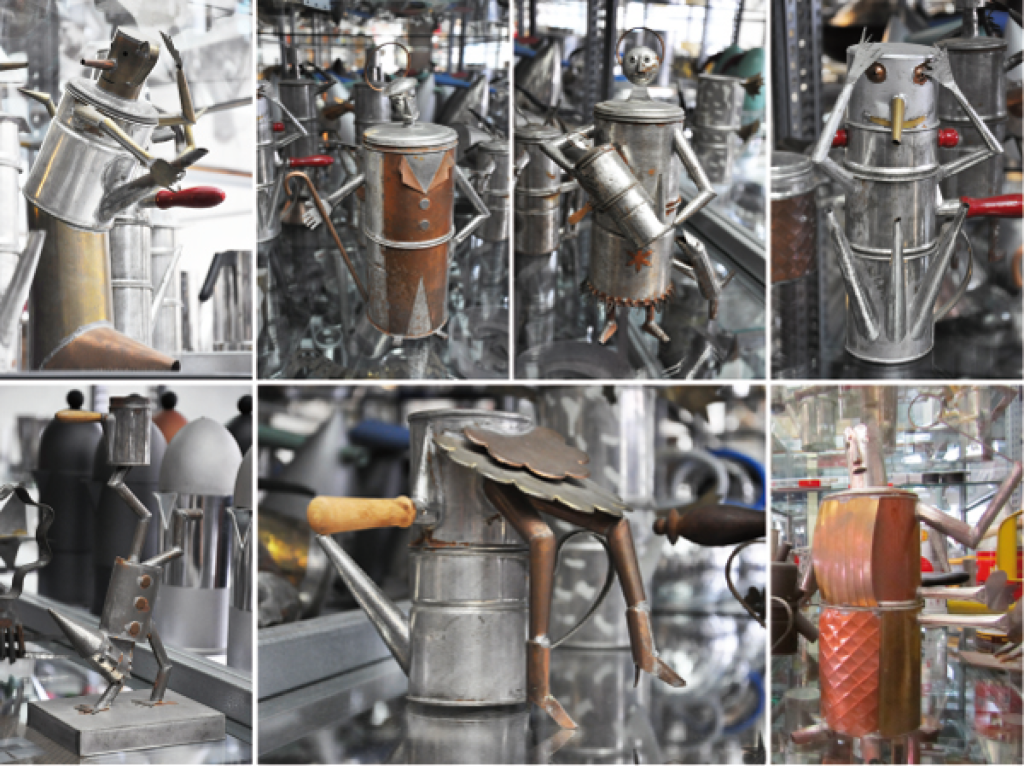
Riccardo Dalisi's Neapolitan Coffee Maker
Tuesday, June 7, 2011
Castiglioni's inventions for his family

Monday, June 6, 2011
Stefano Giovannoni: Embracing Archetypes
Stefano Giovannoni had many words of advice for our class when we visited him at his studio in Porta Genova. Perhaps the most interesting of his insights were his views on the importance of creating a connection between the product and its end user.
He explained how standardized products fail to make sense in a market of non-standardized consumers. Successful products are not then created through the use of shape or form, but an ability to be embedded with a connection to the user. He advised us not to fight the common product typologies that consumers are familiar with, but to augment them through a sense of playfulness. His Girotondo plate, for example, takes the most basic shape of the object type and attempts to connect to the consumer through the integration of a widely accessible symbol.
Mami, a series of pots, synthesizes archetypes in a harmonious way, connecting to the user through a sort of collective memory.
"With Mami, instead of designing a new form, I've tried to rediscover the pot that everybody has in their memory. Mami is granny’s pot, it is the archetype pot. […] Its derived from the traits in the collective memory correspond to the idea of the pot"
Here, Giovannoni focuses attention not on the form, but what the form represents, using the archetype itself as the basis of connection to the user.
What I gathered from this lecture was not to actively resist archetypes or the things society at large is familar with, but to find a way to make them your own -- It's not about making the product unique, but the connection the user has to that product.
Design Studio of Marc Sadler
Marc Sadler is a man who lives in the future. He combines his passion for technology with his dedication for experimentation to create groundbreaking projects recognized around the world. We met with him on a sunny afternoon at his studio nestled in a community of designers. We were invited into his studio, and settled on his very eclectic collection of chairs. No one knew what to expect from this encounter, but he began by pointing out objects scattered around his studio.
He began with the nike slipper he developed, which now numbers 17 million pairs worldwide. This product is a model of all the projects he develops. He began by working closely with the engineers, creating a process that could then be applied to different products. The methodology that he applies to his work is very hands on. He is involved in designing the manufacturing process, creating mock-ups and drawings, and following the project from beginning to end. In this way, he worked closely with injection moulding engineers to pioneer a method for injecting plastic, and from there he took the new technology and applied it to the slippers for nike. In the same way, he revolutionized the sports equipment industry by breaking rules and creating new industrial methods. Such successes include the ski boots for Lotto, and motorcycle gear for Dainese.
Besides his passion for engineering and innovation, he applies aesthetics and a sense of marketing to his products. This explains why he can work on both mass-produced goods and luxury ones. For Dainese, he explained the importance of applying aesthetics to the product. In order to convince motorcyclists to use the safety equipment, he was not just selling the product, but was selling protection. If the product was not appealing, cyclists would not want to use it no matter how life-saving it was. He continues to create and revolutionize products for Dainese and constantly receives feedback from athletes describing ways it has protected them from harm, and suggestions for ways it could be further improved.
Another example of how his aesthetics are applied to his products are the Tite and Mite lamps he designed for Foscarini. He pointed out the mite lamps by the entranceway and from that, he described the combination of engineering with aesthetics. He talked about the technical difficulties of applying kevlar, which was a material then solely reserved for sports equipment, and exploiting its translucent properties for an aesthetic decoration. We saw the determination he had to develop his vision of a unibody lamp. He first experimented in murano glass, which was too fragile, moved on to carbon fibre and then discovered the properties of kevlar. It took the project 4 years to develop after a lot of experimentation and testing the use of a thread forming method. This technical innovation won him the Compasso D'oro award in the year 2000, and created the family of products Foscarini now displays proudly in their showroom.
Keywords: innovation, experience, creativity, technology
Michelle, Alan, Lindsay
Wednesday, June 1, 2011
Vespa: A Cultural Phenomenon
The Little Scooter That Could : Vespa
Piaggio Museum, Florence- June 1, 2011
Practical, sleek and effortlessly glamourous, Piaggio's Vespa is the epitome of classic Italian design. Since its birth in the 1940's, the Vespa has held its place as one of the most iconic vehicles the world has ever seen. An instant phenomenon, Vespa was unlike anything that had ever come before it, and is still unlike anything that has attempted to succeed it. Renowned for its comfort, convenience and innovative form, Vespa revolutionized travel for commuters across Europe, and subsequently, across the planet.
COLOUR TRENDS: SEAFOAM GREEN IS BACK!
On June 1st, we participated in a guided tour at the Vespa museum, where we heard about the development of the Vespa and why it went through all of the changes over the years. The first prototype was developed in 1941 and looked very much like a small motorcycle of that time period.