Piaggio Museum, Pontedera, Firenze - Wednesday, June 1st, 2011
Alan, Michelle, Lindsay

Wednesday, June 1, 2011

Ceramic Production at Richard Ginori
Richard Ginori, Florence - Wednesday, June 1st, 2011
For the most of us who have taken mass pro, I think we all agree that Richard Ginori should be a priority stop for the 2nd year Spring trip (if not just to come to Florence). As for Remi and Justine, they are the two lucky first years that got a glimpse at the mass production of ceramic products. Well, we were all lucky to see behind the scenes in this expansive manufacturing plant.
For the most of us who have taken mass pro, I think we all agree that Richard Ginori should be a priority stop for the 2nd year Spring trip (if not just to come to Florence). As for Remi and Justine, they are the two lucky first years that got a glimpse at the mass production of ceramic products. Well, we were all lucky to see behind the scenes in this expansive manufacturing plant.
Here's a little summary of what we saw:


Rotating mechanisms hold plaster molds which are filled manually with ceramic "slip". The molds must be constantly rotating as the centrifugal motion ensures even wall thickness.
Unusual Scale
Veronica Bogoa, a professor at ISIA, pointed out some elements that make a design stand out and catch people's attention:
1. Opposites
2. Repetition
3. Change of Materials
4. Unusual Environment
5. Unusual Colour
6. Fusion
7. Unusual Scale
8. Similar
9. Movement
10. Weight
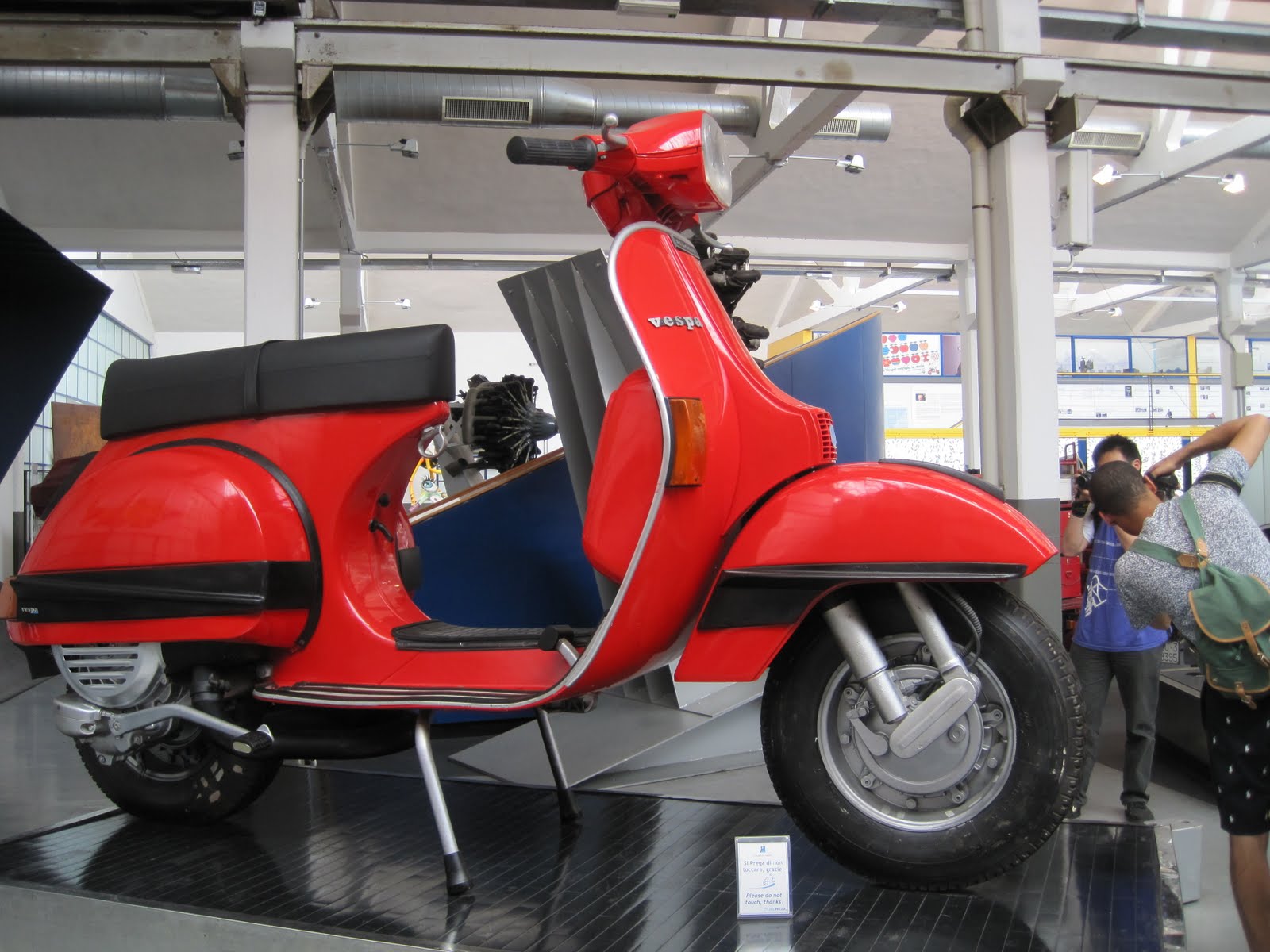
11. Relations (Place vs. Dimensions)She's challenged us to look our for examples of these elements during our stay in Italy (just another hunt for us), so we're keeping our eyes open. Here's an example of the seventh element that we found at the Piaggio Museum, where we got to see so many Vespas!
Richard Ginori - Traditional Production Processes
Richard Ginori - Wednesday, June 1st, 2011
Traditional production processes at the Richard Ginori manufactory
The Doccia porcelain manufactory, Richard Ginori, formerly known as Doccia Porcelain, was founded in 1735 by Carlo Ginori. Our visit gave us a glimpse of its long and rich history, being the first European factory of porcelain that has been in operation since 1737.
The most exciting part was when we got to see the manufacturing process in action. Prior to stepping foot into the factory, and considering the huge developments in technology from the past few decades, one would think that their processes would have altered considerably. However, the very opposite applies. Richard Ginori has maintained their traditional methods of moulding and applying decorations to their products. Almost all applications of decoration are applied by hand, a skill that takes over 10 years worth of experience and training to achieve the quality that the company exhibits. It's no wonder a single ceramic plate could cost up to 1,000 euros! Just as the deco are applied by hand, moulding roses (as illustrated in the video above) is also done in a specific way so that the final product will pertain to the image the company holds. The production of these beautiful pieces will always be done via traditional methods, as claimed by the curator of the Richard Ginori museum, Oliva Rucellai. At the end of the day, I can only admire the skills of the employees and their amazing level of patience in maintaining such traditional practices.
- Alan, Michelle, Lindsay
Keywords: Tradition, Experience
- Alan, Michelle, Lindsay
Keywords: Tradition, Experience
Vespa: A Cultural Phenomenon
Piaggio Museum, Pontedera, Firenze - Wednesday, June 1st, 2011

Youth, adventure, style, modernity: words evoked by the sleek and elegant form of a Vespa scooter. For over 50 years, this two-wheeled vehicle has been known as an icon to generations and a symbold of Italian design. How did a design based on function and accessibility become such a cultural phenomenon?
The Little Scooter That Could : Vespa
Piaggio Museum, Florence- June 1, 2011
Practical, sleek and effortlessly glamourous, Piaggio's Vespa is the epitome of classic Italian design. Since its birth in the 1940's, the Vespa has held its place as one of the most iconic vehicles the world has ever seen. An instant phenomenon, Vespa was unlike anything that had ever come before it, and is still unlike anything that has attempted to succeed it. Renowned for its comfort, convenience and innovative form, Vespa revolutionized travel for commuters across Europe, and subsequently, across the planet.

A classic vespa ad.
A Sketch From Richard Ginori
Richard Ginori, Florence - June 1, 2011


Pictures of the statues being made at Richard Ginori.
- Laura M, Jessica and Kelvin
Subscribe to:
Posts (Atom)